
Review · KUTNA HORA TOURS
Kutna Hora and Bone Chapel Private Day Trip from Prague
Bone chapels and Gothic churches in one tight day. This private Kutná Hora outing trades Prague’s busy streets for UNESCO sights, St. Barbara’s Cathedral, and the Sedlec Ossuary, guided in English with convenient hotel pickup and drop-off.
I love the full-day flow here, because you’re not just ticking boxes. You get a guided route through medieval silver-mining Kutná Hora and then into the cemetery-church world of Sedlec, where the story moves from 14th-century death to 18th-century decoration.
One thing to consider is that the biggest sights have paid entry fees, and while most experiences are smooth, one guest reported the guide was distracted with texting and calls during the drive. If nonstop commentary is your priority, ask for your guide’s plan upfront so the day stays focused on you.
In This Review
- Key Things I’d Bet On
- From Prague to Kutná Hora, Without the Headache
- St. Barbara’s Cathedral: Kutná Hora’s Mining-Era Signature
- Rejsek Square Stone Fountain and the Water That Saved a Town
- St. James Church and the Skyline of a Silver Town
- Jesuit College, Statues, and a Charles Bridge Echo
- St. John of Nepomuk: Kutná Hora’s Only Baroque Church
- Italian Court: Where Wenceslas II Centralized Coin Power
- Kamenny Dum, a Gothic House with Human-Scale Clues
- Sedlec Cathedral: Gothic Grandeur Meets Baroque Design
- The Cemetery Church and the Sedlec Ossuary That Actually Has a Plot
- Timing, Walking Pace, and What to Bring for a 7-Hour Day
- Price and Value: What You Pay, and What Fees Add On
- Should You Book This Kutná Hora and Bone Chapel Private Day Trip?
- FAQ
- How long is the Kutná Hora and Bone Chapel private day trip from Prague?
- What is included in the tour price?
- What entrance fees are not included?
- Is lunch included?
- What meeting point does the tour use in Prague?
- How does pickup work if I am staying in an Airbnb?
- Is the tour private or shared?
- What language is the tour offered in?
- Is there a dress code?
- What is the cancellation policy?
Key Things I’d Bet On
- Hotel pickup and drop-off from a central Prague meeting point, plus an air-conditioned vehicle for the ride
- St. Barbara’s Cathedral first, so the whole silver-mining story clicks early
- Sedlec Ossuary context including the 1870 bone arrangement by František Rint and what’s made from the bones
- Rejsek Square Stone Fountain details like its 1493 date and water delivery by wooden pipes from 4 kilometers away
- Italian Court and Wenceslas II’s money reform, with Florentine bankers and coin production
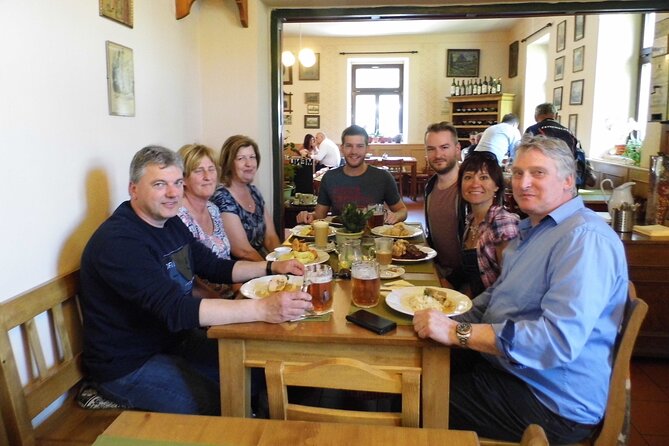
- A lunch break you can actually enjoy, with a local Czech restaurant recommendation (lunch is your own expense)
From Prague to Kutná Hora, Without the Headache
The best thing about this trip is that it feels like you’re using Prague as a base, not wrestling your way across the Czech countryside. You start at the Prague Marriott Hotel area (V Celnici 8, Nové Město), and you return there at the end. Pickup can also be from your hotel or Airbnb as long as you share the exact address in advance.
The ride itself matters more than you’d think. Kutná Hora is far enough from Prague that you’ll want comfort, and this tour uses an air-conditioned vehicle plus bottled water. That helps you arrive ready to walk, not drained.
And because it’s a private experience, you get something rare in day trips: your timing is more flexible. Your guide can pace things based on your group’s questions, and you’re not stuck watching everyone else’s pace.
More Kutna Hora trips:
- From Prague: Kutna Hora UNESCO Site Tour with Bone Chapel
★ 4.6 · 1,917 reviews - From Prague: Kutná Hora, St.Barbara’s Church, Sedlec Ossuary
★ 4.3 · 851 reviews - Kutná Hora from Prague – The Bone Church & St. Barbara’s
★ 4.3 · 620 reviews
St. Barbara’s Cathedral: Kutná Hora’s Mining-Era Signature
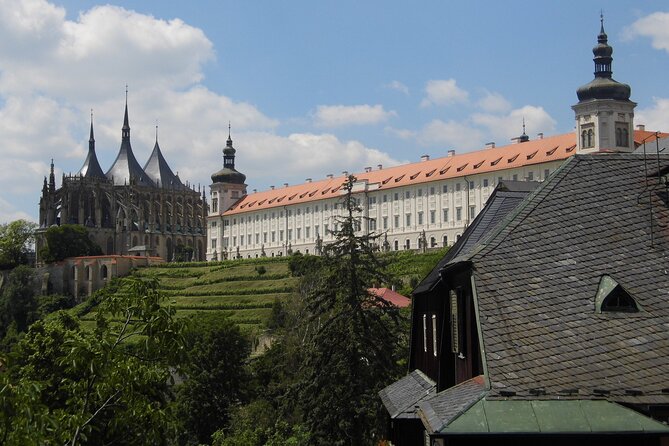
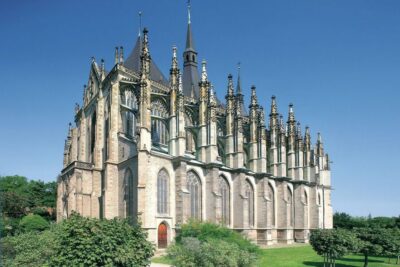
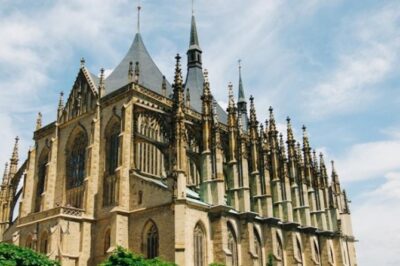
Your first big stop is St. Barbara’s Cathedral, the late Gothic showpiece that Kutná Hora is basically built around. The church is tied to the mining world, consecrated to St. Barbara, patron saint of miners. Expect a dramatic visual that feels designed to impress, not just to worship.
A few details make it click. The cathedral’s three-tent roof and intricate flying buttresses are the kind of late Gothic engineering you can spot even if you’re not a church-architecture person. It also carries the weight of UNESCO recognition for the medieval center, which is why your guide starts here instead of saving it for later.
Practical note: admission is required for this stop, and it’s listed as not included. If you plan your day around the paid entries, start with this one. It sets the tone for everything else, including why silver made the town so powerful.
Rejsek Square Stone Fountain and the Water That Saved a Town
Right near the center is the Gothic Stone Fountain in Rejsek Square, built in 1493 by Matěj Rejsek. You get a great “wait, that’s cool” moment here, because it’s not just decorative. The fountain was used to supply water when mining disrupted local supply.
The fountain is twelve-sided and about four meters tall, and it originally had a hexagonal roof. The most memorable detail is how far they had to reach: water was brought in from a well four kilometers away using wooden pipes. That’s the kind of practical engineering story that turns a pretty object into a real slice of everyday medieval problem-solving.
It’s also the kind of place you can appreciate without rushing. Admission isn’t needed, so you can just step in, look up, and let your guide connect the dots to mining life.
St. James Church and the Skyline of a Silver Town
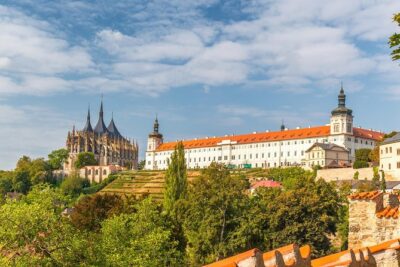
Next comes the Church of Saint James, also known as the high church due to its tall tower plan. Construction began in 1330 and ran until 1420, and it sits as a defining landmark on Kutná Hora’s skyline.
There’s a story behind its shape. The church was originally projected with two towers, but the ground under the site became too unstable because of silver mining. The unfinished second tower is visible on the exterior, which makes the building feel honest. You’re seeing how wealth and mining risk shaped real architecture outcomes.
Inside, you’ll find a mix of Gothic, Renaissance, and Baroque artifacts. Since entry is listed as not included, this is another stop where your tour budget should account for the fee if you want to go beyond the exterior.
More day trips out of Prague:
- VIP Best Reviews: Bohemian & Saxon Switzerland from Prague
★ 5.0 · 3,050 reviews - Bohemian & Saxon Switzerland From Prague-Travelers’ Choice 2025
★ 5.0 · 2,475 reviews - From Prague: Terezin Concentration Camp Guided Tour w/ Audio
★ 4.6 · 2,248 reviews - From Prague: Full-Day Trip to Český Krumlov
★ 4.6 · 1,172 reviews
Jesuit College, Statues, and a Charles Bridge Echo
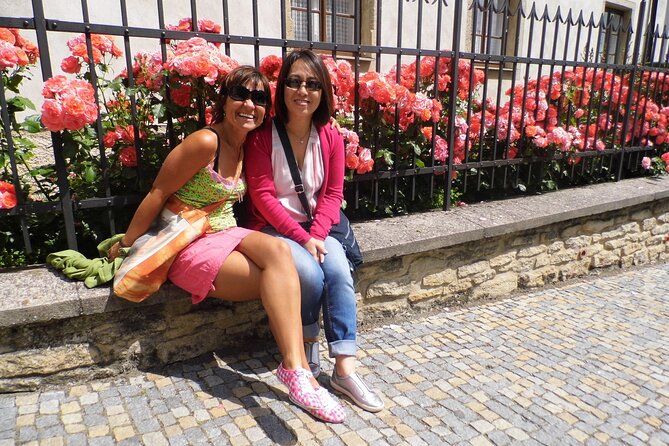
If you want a break from pure medieval mining lore, the Jesuit College stop is a smart pivot. Jesuits arrived in Kutná Hora in 1626, aiming to convert the Utraquist town to Catholicism, and they set up a college next to St. Barbara’s Cathedral, connected with a covered bridge.
The building story stretches across time. It was built from 1667 into the mid-18th century, and it originally had three towers, but the middle one was removed in the 19th century for stability. Then comes the visually clever part: there’s a man-made terrace in front with 13 statues of saints, designed as a pseudo-bridge look, meant to resemble Prague’s Charles Bridge and Royal Route.
Today, the building is used as a large art gallery. Even if you don’t go inside, the exterior gives you a sense of how Kutná Hora borrowed big-city presentation while still staying itself.
St. John of Nepomuk: Kutná Hora’s Only Baroque Church
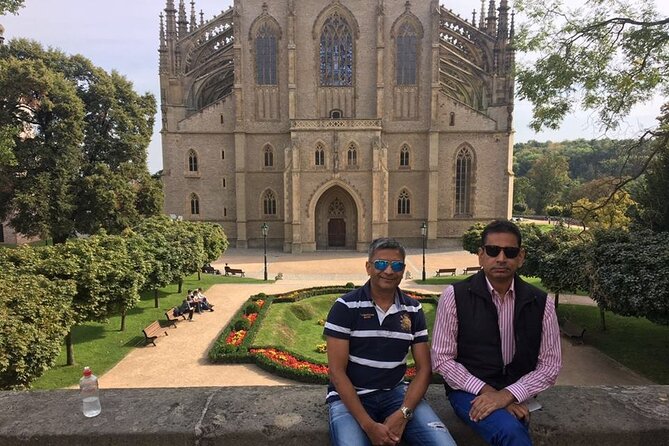
Church of St. John of Nepomuk in Husova Street is your Baroque change of pace. It’s described as the only Baroque church in Kutná Hora, built in the mid-18th century, and partly attributed to Kilián Ignác Dientzenhofer.
If you like churches you can actually feel in your eyes, this is the stop. The reason to go is the richly decorated interior, plus the practical fact that the space can host concerts and exhibitions. That often means the building is active, not a museum shell.
Admission isn’t required for the stop as listed here, so it’s a good time to slow down. Even a short visit helps you notice how Kutná Hora’s religious architecture evolved after the town’s silver peak.
Italian Court: Where Wenceslas II Centralized Coin Power
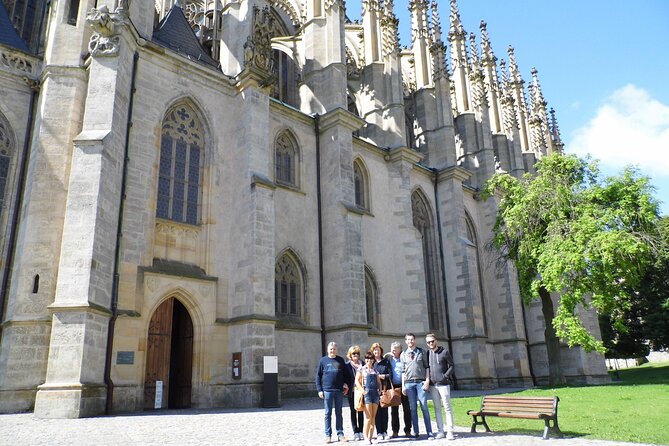
The Italian Court is where the tour shifts from cathedrals to something more grounded and instantly practical: money. This is the medieval site where silver coins were produced during the town’s wealth boom.
It’s named after Florentine bankers who were summoned by King Wenceslas II around 1300 for his monetary reform. The reform closed scattered mints across the kingdom and created a central mint in Kutná Hora’s Italian Court.
What you get from your guide here is the bigger point. The silver Prague groschen coins replaced weaker, thinner silver coinage used before. In other words, Kutná Hora wasn’t only extracting silver, it was turning it into authority, with Europe-strength currency for its time.
Admission is not included for this stop, so it’s a good one to prioritize if you want coin-and-economy history.
Kamenny Dum, a Gothic House with Human-Scale Clues
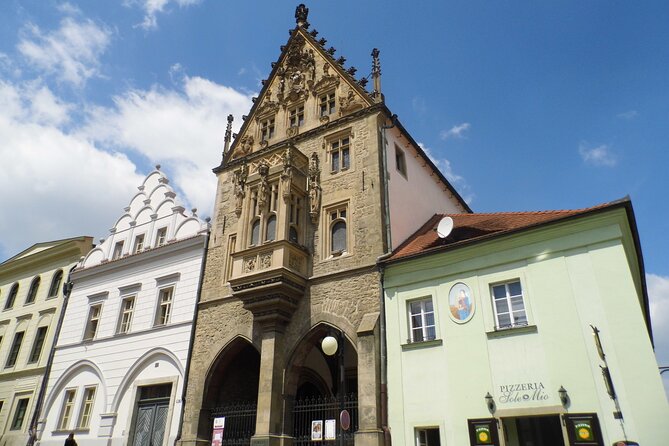
The Gothic Stone House, Kamenny dum, is one of the more “you can picture real life” stops. This building is important in Czech architecture, and it’s valued not just for age, but for the signs of how people lived.
You might not get a full-room museum experience unless the site is open in a particular way, but even the exterior presence helps. It breaks up the day so you’re not only seeing religious monuments and civic spectacle.
Admission is listed as free for this stop, so it’s a low-cost way to add texture to your day.
Sedlec Cathedral: Gothic Grandeur Meets Baroque Design
Now the tour moves to Sedlec, and that’s where the vibe changes fast. You visit the Cathedral of the Assumption of Our Lady and St. John the Baptist, part of the former Cistercian monastery established in the early 1300s under King Wenceslas II.
This cathedral is UNESCO-protected, and it’s tightly tied to the silver era. After all, this monastery rose during Kutná Hora’s greatest wealth from silver mining, when the town could afford impressive religious statements.
Construction is described as High Gothic, and the monastery and church were later burned down by the Hussites in 1421. What makes it especially interesting is the rebuild. In the early 18th century, Jan Blažej Santini rebuilt the monastery at the turn of the 17th and 18th century in a unique Baroque Gothic style. You can see the combination of Gothic and Baroque as one unified design rather than two separate layers.
There’s also a later twist that your guide can point out. The monastery closed down in 1783 during Emperor Joseph II’s religious reforms, then a tobacco factory was established there in 1812 and runs under Philip Morris today. It’s a reminder that buildings keep getting repurposed long after their original purpose fades.
Admission is not included, so budget for the entry fee if you want to go inside.
The Cemetery Church and the Sedlec Ossuary That Actually Has a Plot
You’ll see the Church of All Saints first, the cemetery church that dates from the end of the 13th century and was rebuilt in the Baroque style in 1698. It’s not just a church location, it’s the setting for what comes next: the ossuary beneath.
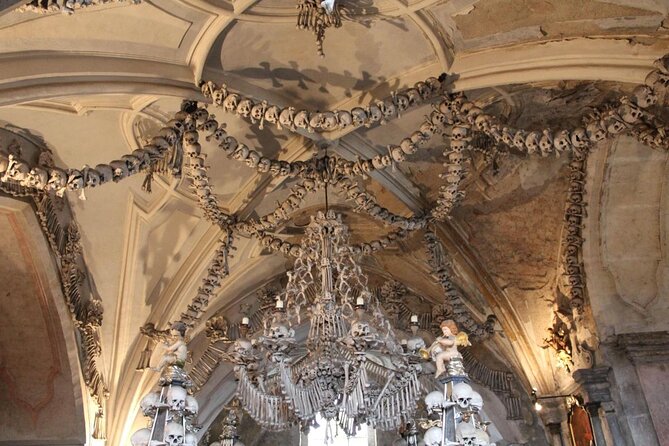
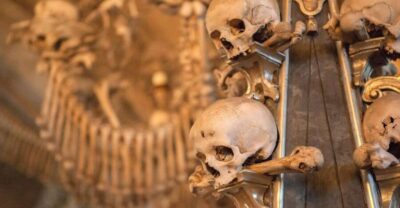
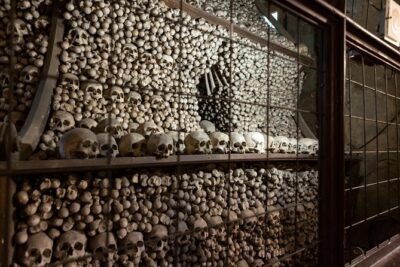
Then you step into the Sedlec Bone Ossuary, inside the undergound chapel of the Church of All Saints. The ossuary contains the bones of about 40,000 people, connected to deaths from the plague in 1318 and from the Hussite wars in the 15th century. Bones were originally buried at the church cemetery, then transferred when the cemetery closed at the end of the 15th century.
Here’s the part that turns macabre into history you can discuss: in 1870, František Rint of Česká Skalice arranged the bones and skulls into decorations. Your guide can walk you through what those decorations include, such as bells, the Schwarzenberg coat-of-arms, and a chandelier.
It’s hard to summarize the mood without sounding dramatic, because the point is not shock. The point is meaning. This place shows how a community dealt with mass death, and how later generations turned what remained into art and symbols.
One practical note: this part of the day is inside an underground chapel, so you might feel cooler than you expected. Bring a layer, even in warmer months.
Timing, Walking Pace, and What to Bring for a 7-Hour Day
This trip runs about 7 hours, and the stops are arranged so you can see a lot without sprinting. Some visits are short, like 15 minutes at points around the center, while cathedral time is longer. Your guide will likely keep you moving between sites, but there should be enough pauses for photos and questions.
Physical fitness is listed as moderate. You’ll be walking, and you’ll likely climb small amounts of stairs depending on the buildings. Wear comfortable shoes that don’t hate cobblestones.
Dress code is smart/casual. That’s an easy standard, but it’s still worth dressing respectfully for church interiors. Also, bottled water is included, so you can focus on not overpackaging your day.
If you’re sensitive to the topic of human remains, you should know what you’re signing up for. This is not a vague “bone-themed” stop. It’s an ossuary where decorations are made from bones.
Price and Value: What You Pay, and What Fees Add On
The tour price is $355.27 per person for a private day trip. That’s not cheap, but it’s easier to judge value when you break out what’s included versus what costs extra.
Included:
- Hotel pickup and drop-off
- Air-conditioned vehicle
- Professional guide
- Bottled water
Not included:
- Entrance fees for the cathedral at Virgin Mary and St John the Baptist, listed at €9.00 per person
- Lunch, because you eat at a local Czech restaurant during the day
- Ossuary entrance fee, listed at €9.00 per person
- St. Barbara Cathedral entrance fee, listed at €10.00 per person
- St. James entrance fee, listed at €4.00 per person
If you add the listed main paid entries, you’re looking at roughly €32 total per person for those four items, not counting lunch. That still usually comes out reasonable for a private, guided UNESCO day with multiple paid monuments. And since this kind of itinerary gets booked, it’s smart to plan ahead, especially if you want your dates during high season. The average booking lead time is about 60 days.
Also, the private format is the hidden value. It’s not only about comfort. It’s about getting explanations tailored to your questions, especially with a site like the ossuary where context matters.
Should You Book This Kutná Hora and Bone Chapel Private Day Trip?
You’ll probably love this if you want a one-day, UNESCO-heavy slice of the Czech Republic that goes beyond Prague’s skyline. The mix is strong: Gothic architecture, a medieval water-supply story, coin production tied to Wenceslas II, and then the Sedlec Ossuary with its clearly explained 1870 bone artistry by František Rint.
This is also a good match if you prefer private pacing and hotel pickup. You get to start and finish in Prague without planning buses, then you get guided time at the key monuments rather than wandering with guesswork.
I’d think twice if you strongly dislike paying multiple separate entrance fees, or if you know the topic of human remains will be tough for you. And if you require constant English narration from start to finish, it’s worth being clear with your guide that you want conversation and explanations during the drives.
If you’re trying to choose between this and a more casual group format, the private structure is the reason to pick it. For many people, Kutná Hora is the kind of place you remember later because someone explained why each building and symbol exists.
FAQ
How long is the Kutná Hora and Bone Chapel private day trip from Prague?
It runs about 7 hours.
What is included in the tour price?
The tour includes hotel pickup and drop-off, an air-conditioned vehicle, a professional guide, and bottled water.
What entrance fees are not included?
Entrance fees are not included for St. Barbara Cathedral, the Ossuary (Sedlec Bone Ossuary), the Cathedral of Our Lady and St. John the Baptist in Sedlec, and the Church of St. James.
Is lunch included?
Lunch is not included. You can stop for a traditional Czech lunch at a recommended local restaurant in Kutná Hora.
What meeting point does the tour use in Prague?
The start and end meeting point is the Prague Marriott Hotel, V Celnici 8, Nové Město, 110 00 Praha-Praha 1.
How does pickup work if I am staying in an Airbnb?
Pickup is offered from your hotel or Airbnb if you provide the exact address and the exact name.
Is the tour private or shared?
This is a private tour, so only your group participates.
What language is the tour offered in?
The tour is offered in English.
Is there a dress code?
The dress code is smart/casual.
What is the cancellation policy?
Free cancellation is available up to 24 hours in advance for a full refund. If you cancel less than 24 hours before the start time, the amount paid is not refunded.
Just added around Prague
- WWII and Communism History in Prague’s Old Town Private Tour★ 5.0 · 4 reviews
- Prague: Historical Walking Tour with Focus on World War 2★ 4.3 · 12 reviews
- World War II 4WD Tour from Prague with Lunch★ 4.4 · 3 reviews
- World War II History Tour of Prague’s Old Town★ 5.0 · 4 reviews
- Walking tour of Prague in French : Nové Město★ 4.9 · 16 reviews
- Walking tour of Prague in french: Old Town & Charles Bridge★ 4.9 · 62 reviews
- Organ Concert in St Francis Church Admission Ticket★ 4.5 · 88 reviews
- Unique salt cave in Prague★ 4.9 · 10 reviews
Kutna Hora Tours, compared.
Kutná Hora, St.Barbara’s Church, Sedlec Ossuary
Read our review →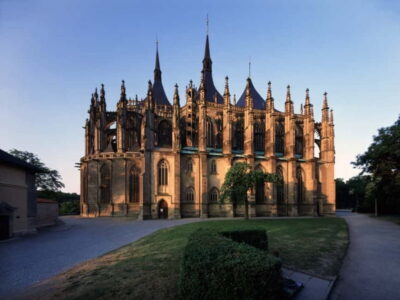
Kutná Hora from Prague – The Bone Church & St. Barbara’s
Read our review →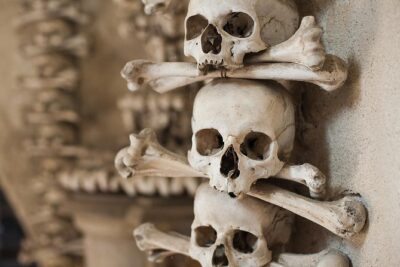
Kutna Hora Day Tour Including Sedlec Ossuary from Prague
Read our review →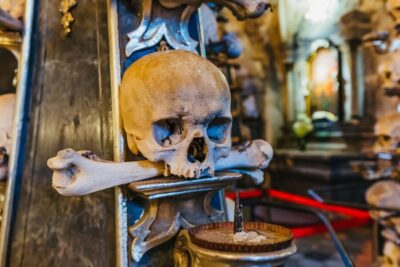
Half Day Trip to Kutna Hora and Bone Church from Prague
Read our review →Browse the lists this tour appears in