
Review · JEWISH QUARTER TOURS
Prague Jewish Quarter Private Half-Day Walking Tour
Prague’s Jewish Quarter hits fast. This private half-day walking tour takes you through the elegant streets of what was once the city’s Jewish Ghetto, with synagogue interiors, cemetery ground, and stories that connect medieval Prague to World War II. I really like how the route mixes important sites with real context, so you are not just seeing buildings, you are understanding what they meant. I also like the personal touch from the guide, including pacing that can flex if you need breaks. One thing to consider: synagogue and museum access requires your own ticket payment, and a few sites have strict rules about seating during services.
If you want a guided route that helps you make sense of the area in just about four hours, this fits well. You’ll stop at major synagogues, hear legends like the Golem, and connect names and families to specific places. The main drawback is timing and access, since the Jewish Museum entrance is extra, and one key synagogue has had reconstruction closures in recent years, which could affect what you see on your dates.
In This Review
- Key points to know before you go
- Why This Private Jewish Quarter Walk Works So Well
- Price and What You Pay for at the Jewish Museum
- Pickup, Route Flow, and How the Timing Usually Feels
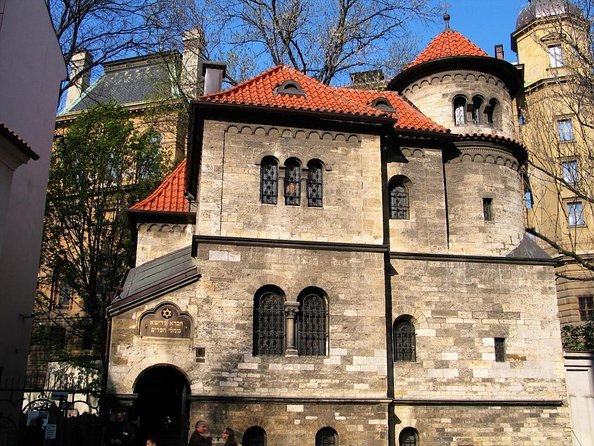
- Old-New Synagogue: Active Worship and Service Rules
- Old Jewish Cemetery: Burials Overlapping by Necessity
- Spanish Synagogue: Moorish Style and the Music Hall Connection
- Klausen Synagogue: Early Baroque in the Former Ghetto
- Pinkas Synagogue: Memorial Inside the Walls
- Maisel Synagogue: A Renaissance Start That Survived Fire
- Jewish Museum Stops: Ceremonial Hall and How to Read the Quarter
- What You’ll Miss If You Go Solo
- Who This Tour Is Best For
- Practical Tips for Your 4 Hours in Prague’s Jewish Quarter
- Should You Book This Prague Jewish Quarter Tour?
- FAQ
- How long is the Prague Jewish Quarter private walking tour?
- Where do we meet, and is pickup available?
- What is included in the tour price?
- Are entrance fees included?
- What language is the tour offered in?
- Can I cancel and get a full refund?
Key points to know before you go
- A private guide with smart pacing, including help for people who need to sit or rest more often
- Big emotional weight in a short route, from synagogue services to the Old Jewish Cemetery
- Jewish Museum stops included on the walk, with the Ceremonial Hall added near the cemetery
- Iconic synagogue styles, including Moorish influences in the Spanish Synagogue and early Baroque at Klausen
- Remembrance built into the walls, especially in the Pinkas Synagogue memorials
- Kafka connections show up on foot, so the quarter feels literary, not just historical
Why This Private Jewish Quarter Walk Works So Well
Prague can feel like a museum from the outside, all stone and spires. This experience makes it feel human. You walk through a district that was once fenced in by history, and you see how daily life, worship, learning, and grief all had physical addresses. In a few hours, you go from active synagogue life to a cemetery where burial limits shaped the ground itself.
Two things I like a lot about the way this tour is set up. First, you get guided stop-by-stop interpretation, not generic facts. You’re shown how each building’s architecture and function mattered, like why women are separated from men during services in the Old-New Synagogue. Second, the guide is not just a lecturer. Eva, the provider behind the tour, is consistently described as friendly, energetic, and fun to be with, and her English communication is clearly strong.
The other reason it works is the structure. You cover seven synagogue-related stops plus the Jewish Museum area in one half-day window. That means you’re not spending your precious Prague time trying to guess what order to visit, what matters most, or how long each site realistically takes.
More Jewish Quarter tours in Prague:
- Prague: Jewish Quarter Walking Tour with Admission Tickets
★ 4.7 · 3,729 reviews - Prague: Old Town and Jewish Quarter Guided Tour in German
★ 4.8 · 3,143 reviews - Prague: Old Town and Jewish Quarter Guided Walking Tour
★ 4.6 · 2,847 reviews
Price and What You Pay for at the Jewish Museum
The tour price is $192.04 per person for a private half-day walking experience of about four hours. You’re paying for the local guide and the fact that you are walking with only your group, not squeezing into a larger tour flow.
Here is the budget reality: entrance fees are not included. The big one is the Jewish Museum entrance fee, listed as €25.00 per person. That is the cost to plan around, especially if you visit on a day when multiple museum or synagogue areas require tickets. Since the tour includes several Jewish Museum administered sites, it makes sense to assume you will be paying that fee as part of your total trip cost.
Value-wise, this tour tends to make more sense when you care about depth and you want a guide to handle the “what should we focus on” decisions. If you are the kind of person who likes to ask questions, the private format can feel worth it quickly. If you just want to see the highlights with no extra explanation, a self-guided plan might be cheaper, though you would miss the connections that help the quarter click.
Pickup, Route Flow, and How the Timing Usually Feels
You meet at Prague Marriott Hotel, V Celnici 8, Nové Město, 110 00 Prague. Pickup is also offered from your hotel or other accommodation, as long as you share the exact address, name of the property, or your Airbnb or hostel details.
The walking portion is a key part of why this works. You’re moving through the neighborhood and resetting your sense of direction, rather than jumping randomly across the city. The duration is listed at about four hours, with each stop programmed around short visits, typically 30 minutes, except for one longer stop that runs about 45 minutes.
Dress code is smart/casual, and the tour is described as suitable for most people. If you know you may need to sit, pause, or manage mobility carefully, that matters here. The guide’s flexibility is specifically noted in experience feedback, including help when lines were too long to remain standing and suggestions for rest breaks.
Old-New Synagogue: Active Worship and Service Rules
The Old-New Synagogue is the kind of stop that changes the tone of your visit. You are not just looking at a historical shell. It is still working, meaning services continue inside.
The site is described as the oldest synagogue in Europe and the oldest in the world outside of Israel from 1270 A.D. Even if you already know Prague has deep Jewish roots, seeing a synagogue that has stayed active for centuries makes the history feel less abstract. This stop is about continuity, not just survival.
A major practical consideration: women are not allowed to be present in the area during services. The setup separates women and men, with women hearing some words rather than participating from the main space. In other words, this is a living religious building with clear boundaries. If you visit during a time when services affect access or seating, your guide can help you understand what you are seeing and how it works.
If you care about how religious practice shapes space, this is one of the most important stops. It gives context for everything else you will see afterward, including why memorials and records were kept with such care.
More Walking Tours in Prague:
- Prague: 3-Hour Walking Tour of Old Town & Prague Castle
★ 4.7 · 5,696 reviews - Prague: Ghost Walking Tour Where Legends Come To Life
★ 4.4 · 5,253 reviews - Prague Guided Walking Tour and Cruise with Authentic Czech Lunch
★ 5.0 · 3,627 reviews - Prague Ghost and Legend of Old Town Walking Tour
★ 4.5 · 2,630 reviews
Old Jewish Cemetery: Burials Overlapping by Necessity
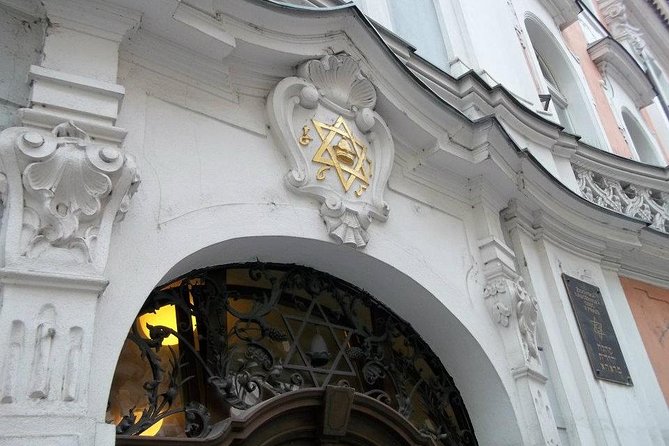
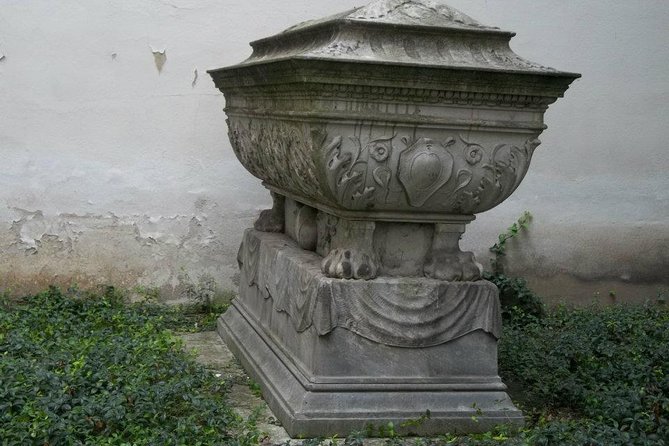
The Old Jewish Cemetery is one of those places where you immediately slow down. It is listed as the oldest still preserved Jewish cemetery in Prague, dating to 1439 A.D., and it holds an astonishing number of people, more than 100,000, laid down in a crowded footprint.
The key story is space. Because there was not room to bury individuals in separate plots, people were buried on top of each other over time. That is not a dramatic metaphor. It is a physical reality you can sense when you walk among the rows. It is also where the emotional weight of the quarter becomes unmistakable.
The cemetery was abolished in 1787 by Joseph II of the Habsburgs. That detail matters because it shows the tension between religious tradition and state policy. You’re not just hearing that the Jewish community endured hardship. You’re seeing how policy decisions had direct consequences on sacred ground.
There is also a legend included on this part of the experience: the tale of the Golem. Even if you approach the legend as folklore rather than literal history, it fits the mood here. It adds a thread of Prague imagination to a cemetery that already feels like a meeting point of memory and myth.
Spanish Synagogue: Moorish Style and the Music Hall Connection
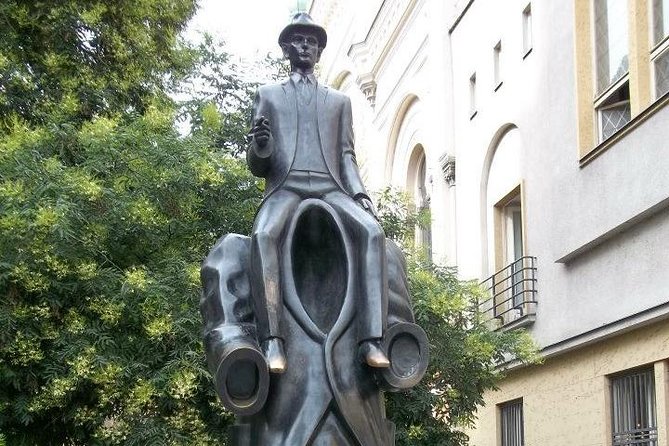
The Spanish Synagogue is one of the most visually striking buildings on the route, and that is saying something in Prague. It was built in 1868 to replace an earlier synagogue from the 12th century, and it is described as Moorish or Moor-inspired in style, with an oriental aesthetic.
The interior is said to resemble the Alhambra in Spain, which is exactly why it is called the Spanish Synagogue. If you love architecture, this is a good moment to pause and look beyond the fact you are in Prague. You are seeing how Jewish communities in different European cities interacted with broader artistic trends.
There is also a practical angle here. The synagogue is used for classical music concerts, which means part of the building’s identity is as a performance space. That can feel unusual at first, but the point is understandable: the room is designed for resonance, and the community has a long relationship with both worship and music.
One planning note: this stop has had reconstruction closures, stated as closing for two years from May 2019. If your dates overlap with any closure, your guide may adjust what you can enter. Since closures can change, your best move is to go into this with flexibility, and let the guide handle the on-the-ground reality.
Klausen Synagogue: Early Baroque in the Former Ghetto
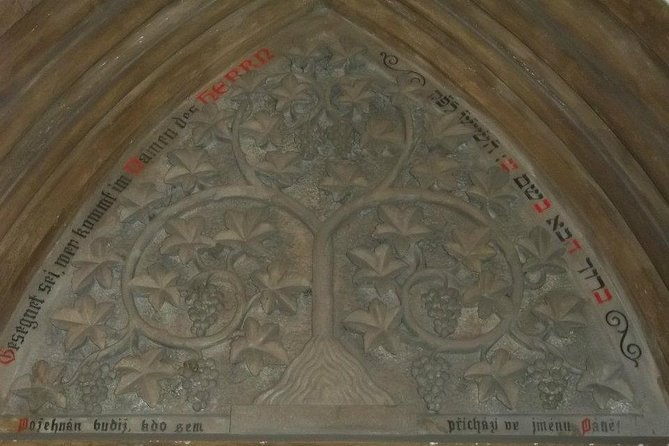
Klausen Synagogue is presented as the largest synagogue in the former Prague Jewish ghetto area and as a single example of early Baroque synagogue architecture in the district.
This is where the tour shifts from “look at the shape” to “look at the role.” A synagogue’s size and style signal status and community needs. The guide helps connect what you see in stone and layout with the historical purpose of gathering, prayer, study, and community identity.
Today, Klausen is administered by the Jewish Museum in Prague. That matters because it tells you the building is preserved within a museum framework, but it is still tied to the living story of the quarter. You’re not only collecting facts. You’re also learning how preservation works when sacred spaces become part of public history.
If you want variety in architectural flavor, Klausen is the stop that adds a Baroque edge to the mix.
Pinkas Synagogue: Memorial Inside the Walls
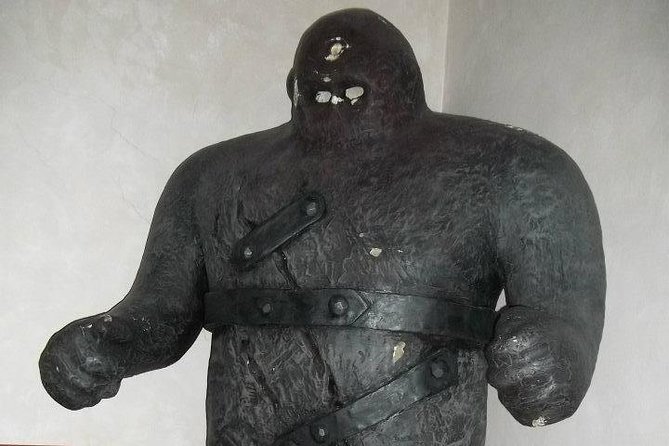
Pinkas Synagogue is described as the second oldest surviving synagogue in Prague, with roots connected to the Horowitz family. It is administered by the Jewish Museum, and this is a stop focused on commemoration.
The key memorial role here is straightforward and heavy. The synagogue commemorates about 79,000 Czech Jewish victims of the Shoah. That number is not just a statistic on a wall. In this kind of setting, it becomes a physical reminder that the modern era inflicted losses on specific communities, not abstract “history.”
When you visit, you will likely feel the change in tone after lighter explanations or architecture talk. It is a moment to let the space do its work. A guided approach helps because you are not left guessing what the memorial means or how it connects to the quarter’s broader story from medieval times through World War II.
Maisel Synagogue: A Renaissance Start That Survived Fire
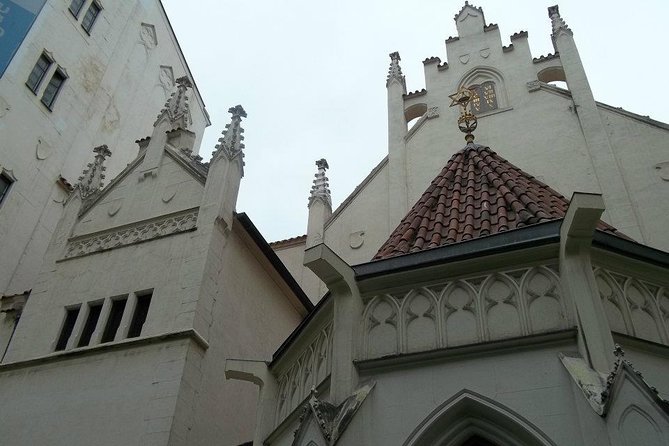
Maisel Synagogue has a richer timeline than you might expect from a single stop. It was erected in 1592 thanks to a privilege granted by Emperor Rudolf II. The founder is identified as Mordecai Maisel, the mayor of the Prague Jewish Town.
Architecture fans will appreciate the “unusual for its day” detail: the synagogue was originally a Renaissance temple with three naves. Then the timeline changes quickly. It burned down in the ghetto fire of 1689 and was rebuilt several times.
The building you see today is shaped by that long repair history. Its current form is Neo-Gothic, dated to 1893 to 1905, attributed to Prof. A Grotte. That sequence makes the stop feel like a story of rebuilding, not just survival.
If you like tours that include cause and effect, this is one of the best examples. You get a clear chain: privilege leads to construction, disaster leads to rebuilding, and later restoration leads to what stands now.
Jewish Museum Stops: Ceremonial Hall and How to Read the Quarter
The Jewish Museum stop in this route includes the Ceremonial Hall, located next to the Old Jewish Cemetery on the site of an old mortuary used by the Prague Burial Society, the Hevrah Kaddisha.
The hall is built in Neo-Romanesque style and dated to 1906 to 1908. The detail that really helps you understand the quarter is the building’s original function. The first floor is described as having a room for ritual washing of the dead, and the second floor once served as the burial society’s club room.
That functional backstory changes how you look at the whole area. You start noticing how Jewish community structures planned for death and remembrance with the same seriousness as worship and daily life. The building’s museum role began later, becoming part of the Jewish Museum in 1926, after it was used for its original purpose until the end of World War I.
This is also where your guide’s pacing matters. The museum component fits into the short route, so don’t expect hours. Instead, think of it as orientation. If you fall in love with what you learn, you can always plan a deeper museum visit on another day.
What You’ll Miss If You Go Solo
You can absolutely do parts of this quarter on your own. But the value of a private guided walk is in the connections.
You will get answers to questions like:
- Why services have rules that affect who can be present and where
- How architecture shifts with time, disaster, and changing tastes
- How major events like the ghetto fire or state actions like Joseph II’s abolition show up in physical places
- How legends such as the Golem fit a city known for storytelling
You’ll also get practical guidance that can save time, including the kind of local food recommendations that go beyond the usual quick-hit tourist spots. In the feedback for this tour, the guide is repeatedly credited with offering helpful suggestions for places far less tourist-y, which can be a big deal after a dense morning or afternoon of history.
Who This Tour Is Best For
This tour suits you best if you want a structured walk that covers the quarter’s most meaningful synagogue sites and the Old Jewish Cemetery within a half-day time frame.
It is especially good for:
- First-timers who feel overwhelmed by where to start
- People who like a guide who can explain rules, not just dates
- Anyone who wants the quarter’s story stitched from medieval times to World War II
- Visitors who appreciate pacing help, since there is a documented track record of adjusting for mobility needs
If you are only looking for quick photos and you hate indoor rules, you might prefer a shorter, exterior-focused option. Some synagogue visits can involve access limits based on the day’s worship activities.
Practical Tips for Your 4 Hours in Prague’s Jewish Quarter
Here are the real-world things that help you enjoy this route more.
Wear shoes that work on uneven streets. Prague’s Old Town footpaths are not always gentle, and you are walking between multiple sites.
Bring a bit of patience. Several stops focus on interior rooms, and the tour’s timing is tight enough that you may feel rushed if you try to do everything on your own too quickly.
Plan on budgeting for the Jewish Museum fee of €25.00 per person. If you show up without factoring it in, it can feel like a surprise tax right when you are ready to enjoy the museum portion.
If you have mobility needs, mention them early. A private guide can often help with pacing and rest breaks when lines or access slow things down.
And if you care about atmosphere, try to visit at a time when you will not feel like you are sprinting across Prague. The emotional tone of the cemetery and memorial synagogue stops deserves a calmer pace.
Should You Book This Prague Jewish Quarter Tour?
I’d recommend booking if you want a guided, private half-day that connects architecture, worship rules, remembrance, and Prague storytelling in one walk. The tour’s standout strength is the human side, Eva’s friendly, fun delivery, and her ability to keep the pace comfortable while still covering major stops.
Before you book, do one quick check: make sure you budget for the Jewish Museum entrance fee and be flexible in case Spanish Synagogue access is affected by reconstruction during your travel dates. If you can handle that, you are set up for a meaningful Prague afternoon that goes well beyond postcard history.
FAQ
How long is the Prague Jewish Quarter private walking tour?
It lasts about 4 hours.
Where do we meet, and is pickup available?
You meet at Prague Marriott Hotel, V Celnici 8, Nové Město, 110 00 Praha-Praha 1. Pickup is offered from your hotel or accommodation if you share the exact address and name.
What is included in the tour price?
The tour includes a professional local guide and a private walking tour. A mobile ticket is also offered.
Are entrance fees included?
No. The entrance fee for the Jewish Museum is listed as €25.00 per person, and entrance fees are not included.
What language is the tour offered in?
The tour is offered in English.
Can I cancel and get a full refund?
Yes. You can cancel up to 24 hours in advance for a full refund. If you cancel less than 24 hours before the start time, the amount paid is not refunded.
Just added around Prague
- WWII and Communism History in Prague’s Old Town Private Tour★ 5.0 · 4 reviews
- Prague: Historical Walking Tour with Focus on World War 2★ 4.3 · 12 reviews
- World War II 4WD Tour from Prague with Lunch★ 4.4 · 3 reviews
- World War II History Tour of Prague’s Old Town★ 5.0 · 4 reviews
- Walking tour of Prague in French : Nové Město★ 4.9 · 16 reviews
- Walking tour of Prague in french: Old Town & Charles Bridge★ 4.9 · 62 reviews
- Organ Concert in St Francis Church Admission Ticket★ 4.5 · 88 reviews
- Unique salt cave in Prague★ 4.9 · 10 reviews
Jewish Quarter Tours, compared.
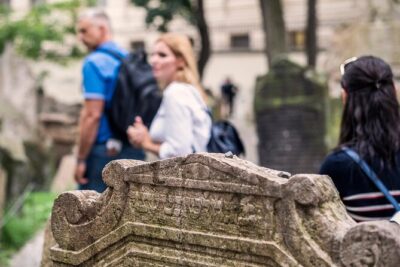
Jewish Quarter Walking Tour with Admission Tickets
Read our review →
Old Town and Jewish Quarter Guided Tour in German
Read our review →
Old Town and Jewish Quarter Guided Walking Tour
Read our review →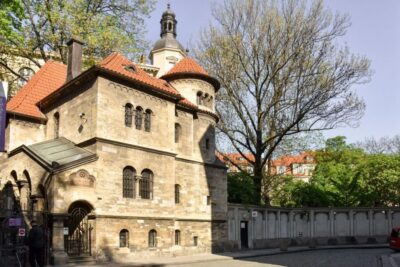
Jewish Quarter Ticket with optional Audio Guide
Read our review →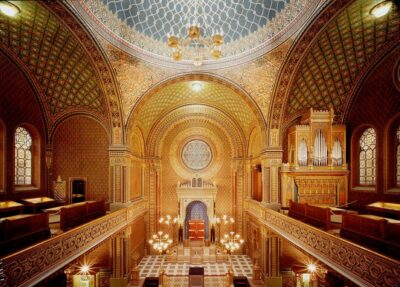
Prague’s TOP Sights – Old Town, Jewish Quarter, Charles Bridge (Tip-based tour)
Read our review →
Prague Old Town New Town and Jewish Quarter Morning Tour
Read our review →
Old Town, Jewish Quarter & Astro Clock Walking Tour
Read our review →Browse the lists this tour appears in